// Case study · AI automation
Explainer Shorts Pipeline — a script goes in, a timed 3D explainer comes out.
@ingpo.gan publishes one-minute Indonesian explainers on news and science. Each episode is a JSON script. An AI voice reads it, and the timestamp of every spoken word becomes the clock for the picture: captions, data cards, map markers and camera moves all land on the word that names them, with no hand-timed keyframes.
// Live demo
Watch the timestamps drive the picture.
Three published episodes with their real timing data. Play one and the transcript follows the voice word by word; click any word to jump there. When a word lights up, check what appears on screen.
press play, or click any wordIndonesian voiceover. Each word above is a real timestamp from the ElevenLabs alignment; the same numbers place every caption, card and camera move in the video.
// 01 · Research
Research first: every number carries a source.
Each episode starts with one question a viewer would actually ask, and the facts to answer it in under a minute. Every figure that appears on screen is shown with its source line at the bottom of the frame.
| Episode | Sources on screen | Length |
|---|---|---|
| Wildfires, part 1 | World Bank (2016): Rp221 trillion loss, 2.6 M ha burned · BNPB & Kompas (2026) · Harvard–Columbia and Newcastle haze studies (2016) | 67 s |
| Wildfires, part 2 | Wetlands International: peat sinks 3–5 cm a year · Hooijer et al. (2012): CO₂ per hectare · IUCN orangutan status · Indonesian laws 32/2009 and 39/2014 | 61 s |
| Starship catch | SpaceX flight updates, BBC/AP, Space.com: tower catches, 33 Raptor engines, re-entry speed and heat | 77 s |
The two wildfire parts were planned as a pair: part 1 asks what happens if the fires in Kalimantan are not contained, part 2 asks what happens to the burned peatland afterwards. Part 2 names no companies and ends on a question for the comments.
// 02 · Script
The script is data.
An episode is one episode.json: global voice settings plus a list of scenes. Each scene names a visual component, the on-screen kicker and headline (asterisks mark the highlighted words), and the voiceover line. Changing the story means editing this file, not the timeline.
{
  "id": "ep09",
  "badge": "KARHUTLA · PART 1/2",
  "engine": "elevenlabs", "model": "eleven_v3", "seed": 7,
  "scenes": [
    {
      "visual": "khHook",
      "kicker": "KARHUTLA",
      "headline": "Rugi *Rp221 triliun*",
      "vo": "Eh, lu tau nggak? Tahun 2015, kebakaran hutan di Indonesia
             bikin rugi dua ratus dua puluh satu triliun rupiah. ..."
    },
    ...6 more scenes
  ]
}- Written for a voice: casual Jakarta Indonesian, numbers spelled the way they are spoken, no ALL-CAPS (the TTS model reads them oddly).
- Hook in three seconds: the first line states the most surprising number; a follow prompt sits mid-video, not at the end.
// 03 · AI voice
One AI take, split into words and scenes.
The whole script goes to ElevenLabs as a single request, so the delivery stays consistent across scenes. The with-timestamps endpoint returns the audio together with a start and end time for every character. A Python script (scripts/tts.py) turns that into word timings per scene:
POST /v1/text-to-speech/{voice}/with-timestamps     # one take for the whole episode
  → mp3 + alignment (start/end time for every character)
  → characters grouped into words (punctuation stripped, pauses flagged)
  → words cut into scenes at each scene's first character
  → scene lengths in frames at 30 fps (+1 s tail after the last word)
  → optional speed-up via ffmpeg atempo: every timestamp is rescaled with it
The result is props.json: the same scenes, now with exact word timings and frame counts.
"words": [
  { "text": "Eh",    "start": 0.000, "end": 0.240, "brk": true },
  { "text": "lu",    "start": 0.267, "end": 0.320 },
  { "text": "tau",   "start": 0.360, "end": 0.480 },
  { "text": "nggak", "start": 0.507, "end": 0.800, "brk": true },
  ...
],
"audio": "ep09/vo.mp3", "audioFrom": 0, "frames": 269- Fixed voice and seed: one custom voice, model
eleven_v3, seed 7, so re-generating a line sounds like the same narrator. - Pronunciation check: word durations are inspected after every take; a word that is far too short or long means the model misread it, and the spelling in the script gets adjusted.
- Cheap fallback: the same script can run on Microsoft edge-tts for drafts, with the same output format.
// 04 · Word sync
Animation cued by words, not by keyframes.
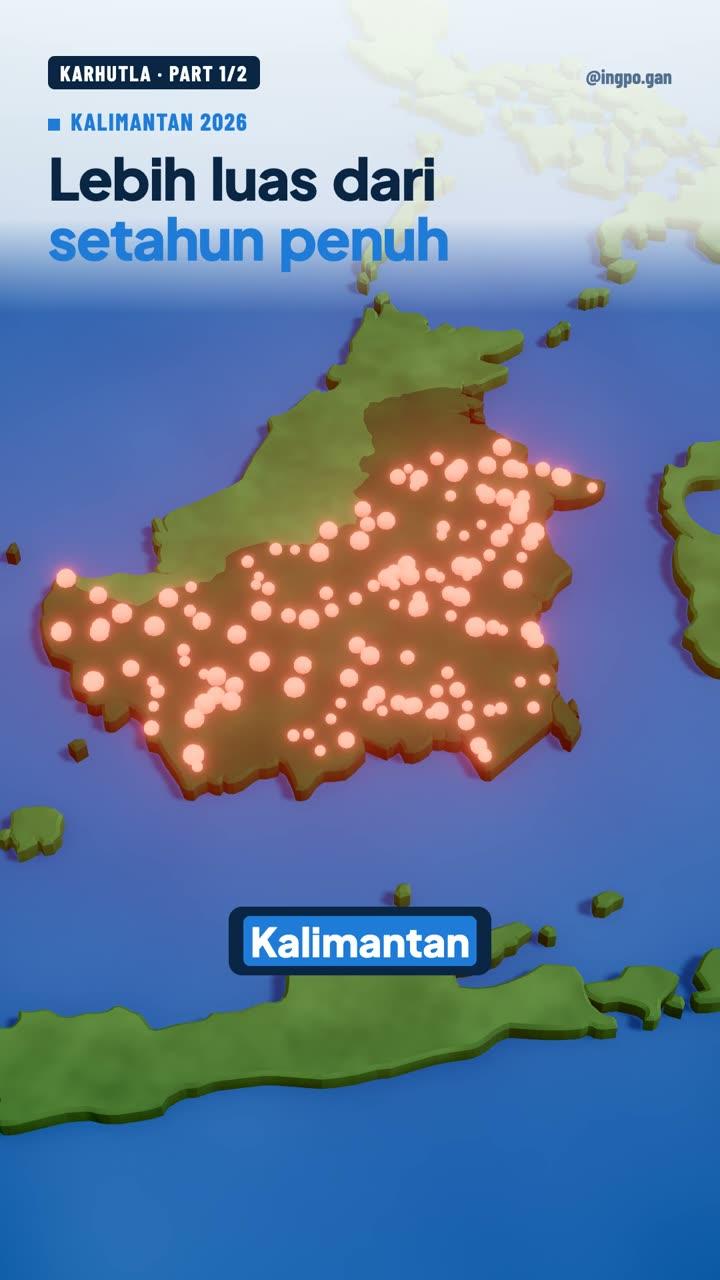
Every scene in Remotion receives a cue() function built from its word list. Animations ask for a word and get back the frame it is spoken on, so the map lights up on “Kalimantan” and the loss card pops on “dua” (as in dua ratus dua puluh satu triliun).
// a word → the frame it is spoken on
const cue = makeCue(scene.words);

<Hotspots count={lerp(0, 60, ease(f, cue('Kalimantan') - 20, cue('Kalimantan') + 30))} />
<CityLabel text="KALIMANTAN" p={pop(cue('Kalimantan'))} />
<Card label="KERUGIAN KARHUTLA 2015 · WORLD BANK" p={pop(cue('dua'))}>
  Rp221 triliun
</Card>
If a line is rewritten and re-voiced, every animation moves with it. Nothing needs re-timing by hand. A missing cue word throws an error at render time instead of silently drifting.
// Starship: HUD cards declared as data, each pinned to a spoken word
const CARDS = {
  hook:    [{ at: 'setinggi',  label: 'TINGGI ROKET',              value: '± 120 m' }],
  stack:   [{ at: 'mesinnya',  label: 'BOOSTER SUPER HEAVY',       value: '33 mesin Raptor' }],
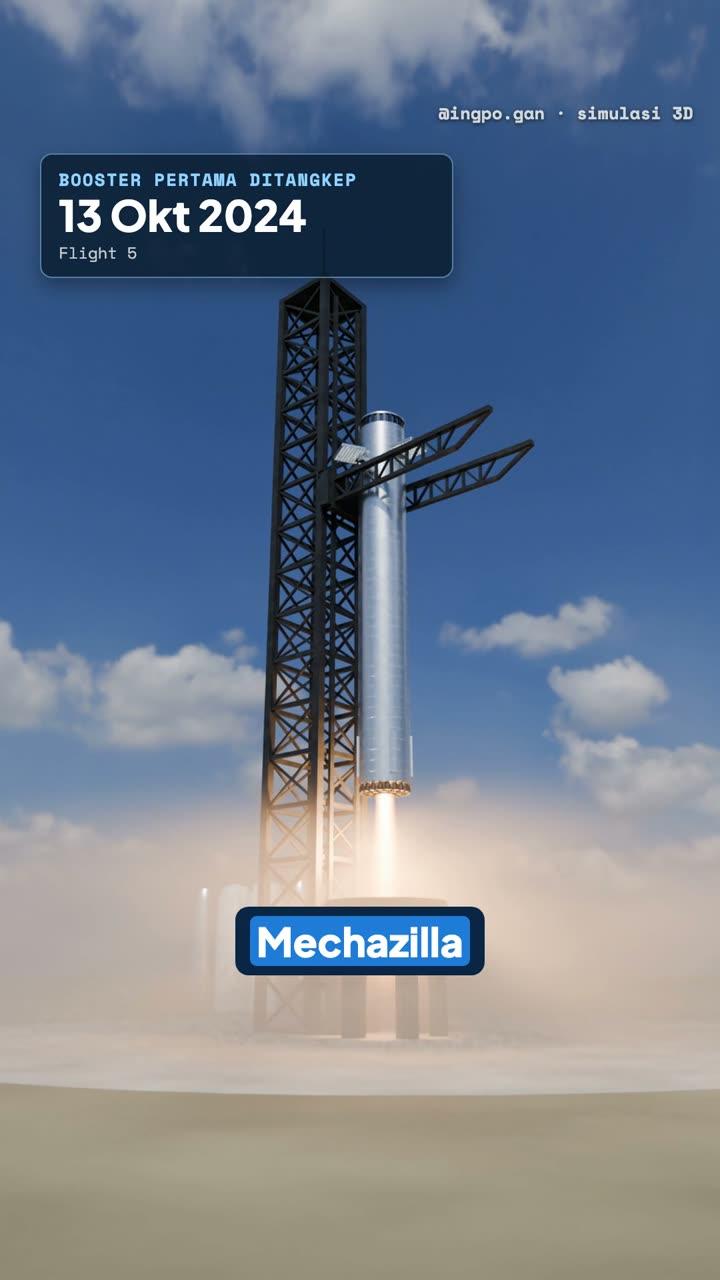
  catch:   [{ at: 'lengan',    label: 'BOOSTER PERTAMA DITANGKEP', value: '13 Okt 2024' }],
  reentry: [{ at: 'kecepatan', label: 'KECEPATAN PULANG DARI ORBIT', value: '± 27.000 km/jam' }],
};
Karaoke captions use the same data: the current word is highlighted from its start to its end time.
// 05 · 3D scenes
Two ways to build 3D scenes.
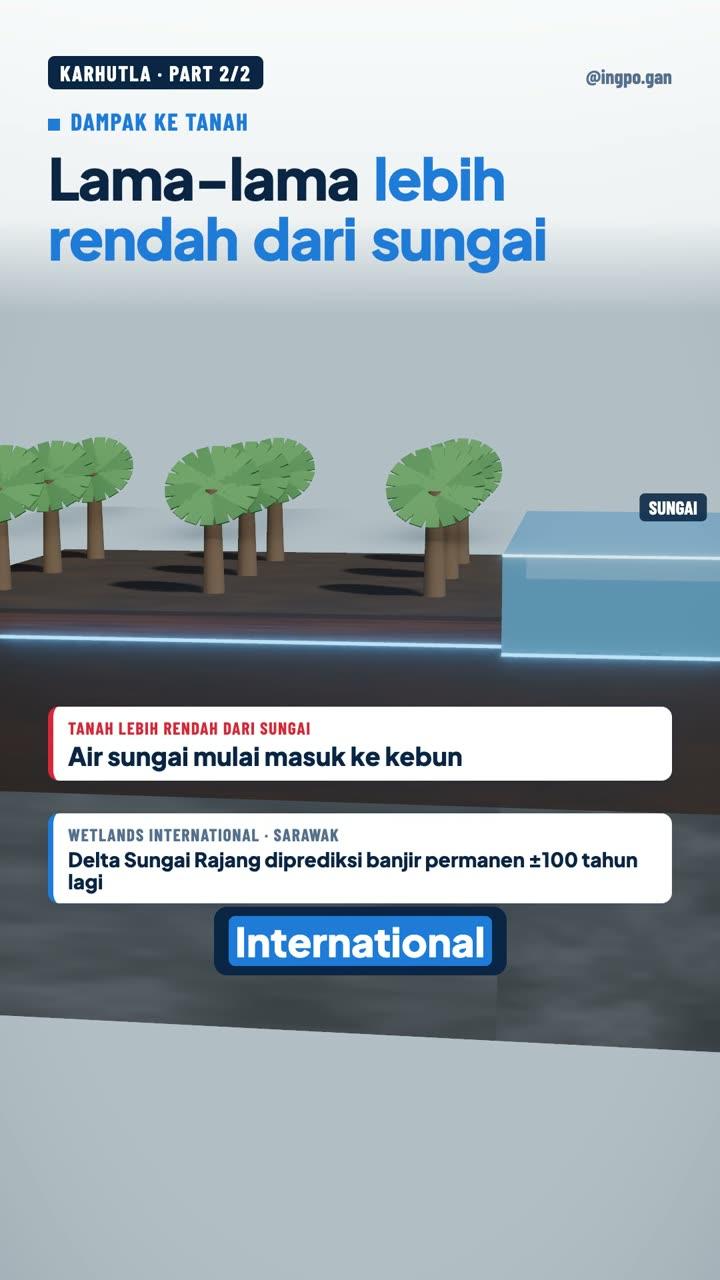
Wildfires: Three.js inside the video. The map is extruded from real country outlines (world-atlas, 1:50m) and rendered with react-three-fiber inside Remotion. Post-processing adds ambient occlusion, bloom on the fire hotspots, and AgX tone mapping; the embers are a custom GLSL shader. Part 2 reuses part 1’s kit for a peatland cross-section that sinks below the river over time.
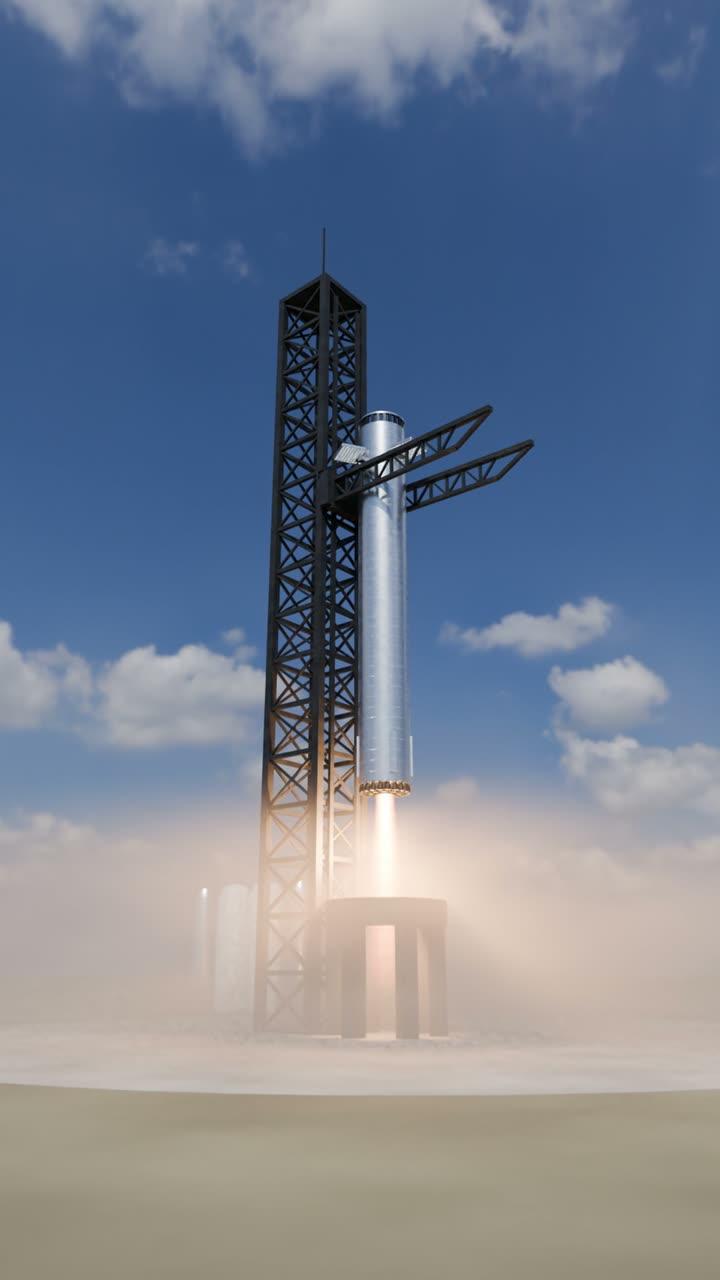
Starship: a Blender simulation under the overlay. A generic two-stage rocket and catch tower are built in a Python script for Blender (about 950 lines, Cycles renderer, no logos). Every shot is a function of the frame number rather than keyframes, and renders resume where they stopped. Remotion then adds the karaoke captions, HUD cards and sound effects on top, cut to the voiceover scene lengths.
// 06 · Render & QA
Render, check, normalise.
npm run tts episodes/ep09/episode.json        # voice + timings → props.json
npx remotion render src/index.ts Episode out/ep09.mp4 --props=episodes/ep09/props.json --gl=angle
ffmpeg -i out/ep09.mp4 -c:v copy -af loudnorm=I=-14:TP=-1.5:LRA=11 \
-c:a aac -b:a 192k -movflags +faststart out/ep09_final.mp4- Framing QA before the long render: a script renders a low-res preview with the presenter drawn in flat magenta, then measures how much of each sampled frame he fills and flags frames where one flat colour dominates (a camera stuck inside a wall).
- Contact sheets: one frame every few seconds tiled into a single image, to review a whole cut at a glance.
- Loudness: every final file is normalised to −14 LUFS, the level short-video platforms play at.
// 07 · Publish
One file, three platforms.
The output is a 1080×1920, 30 fps MP4 that goes to Instagram Reels, TikTok and YouTube Shorts under one handle, with a title card, captions and the source line burned in, so the video works with the sound off.
// 08 · Results
Results.
My part, and how it was built
I came up with the format, researched and fact-checked each topic, wrote every script, directed the voice and the visuals, and reviewed each cut before publishing. The code was pair-programmed with Claude Code, Anthropic’s AI coding agent: I described what each scene and tool had to do and reviewed the result, and the agent wrote most of the implementation. Working this way is a large part of how 27 episodes fit into 17 days.
Honest limitations
- A new topic usually needs new visual components. The pipeline automates timing and assembly, not the art.
- 3D episodes are slow to render: about 10 minutes in Remotion, longer for Blender shots.
- The TTS model still misreads some slang and numbers, so a human checks every take.
- The repository is private; the timing data and videos on this page are real exports from it.